Think you know a lot about chronic pain? Test your knowledge and Click Here to take the pain quiz!
0:00 – Intro
7:05 – What are your thoughts on mobility work?
12:47 – What is your approach and how do you find a balance between gaining muscle and attaining mobility?
38:29 – What are some of the exercises that tend to create the most common problems?
41:38 – How can someone determine their ankle mobility?
45:21 – How about the bench press and its relation to shoulder pain?
47:41 – What are your thoughts on rotator cuff exercises?
56:22 – What are your thoughts on massage guns and foam rollers?
1:09:44 – Where can people find you and your work?
]]>
How To Sit With SI Joint Pain
Sitting with SI joint pain for any length of time can make you miserable. Unfortunately there isn’t just “one fix” that will work for everyone all the time.
Instead, there are a number of things that can help reduce sacroiliac region discomfort. They need to be tested to find out which works best.
However, the key reason why most people feel pain when sitting is because of a lack of movement. Tissues, and especially nerves, need blood flow and oxygen to reduce increased sensitivity.
This is especially important to remember because at the end of the day, you need to MOVE as a human being, and not doing so simply cannot be worked around by using an expensive ergonomic chair, creams, pills, etc.
That said, lets get to our how to sit with SI joint pain list.
How To Sit With SI Joint Pain – Seated Hip Shift Mobilization w Ball
My favorite recommendation to reduce discomfort when sitting and introduce movement is with the Seated Hip Shift Mobilization.
Since we are all asymmetrical (not balanced front/back/left/right), we tend to have favorite sides to sit on, muscles to use more, etc.
These asymmetries can be exacerbated in our daily activities, so we need to be conscious of using both sides of our body. This movement in particular will help accomplish this task while sitting.
Here is how to do it:
- Sit upright with your feet flat on the floor and with your hips slightly higher than knee level.
- Place a small ball or yoga block between your knees. (even a rolled up towel or pillow will work)
- While keeping your feet flat on the the ground, shift your weight to one side and pull your hip back while simultaneously pushing the opposite hip forward.
- Hold this position for 1-2 seconds, then repeat on the other side.
- Shift from side to side until you start to feel some fatigue, you start to lose good form, or feel any discomfort.
When you perform this hip shifting maneuver, it’s essentially “pumping” the hips and lower back. You need to make sure this movement is done with low intensity. It’s not about forcing the range of motion or building strength or anything else. Just introducing movement, getting blood flowing, and relaxing overly sensitive nerves.
How To Sit With SI Joint Pain – Seated Hip Shift Mobilization w Band
This option is almost identical to the previous one, but in this version you will place a light mini-band around your knees.
The first version emphasizes the groin muscles to pull the hip back, and this version emphasizes the glutes to slide the opposite knee forward, but also to decelerate the same side hip as it goes back.
Yeah, that can sound a bit confusing, but the point is those muscles need to do both. In addition, adding a bit of resistance to the glutes further helps you to feel them and also get a bit of a muscle pump for blood flow.
Here is how to do it:
- Sit upright with your feet flat on the floor and with your hips slightly higher than knee level.
- Place a light-moderate mini-band above your knees. (don’t go too heavy on this as it will distort the movement!)
- While keeping your feet flat on the the ground, shift your weight to one side and pull your hip back while simultaneously pushing the opposite hip forward. Maintain the tension outward against the band with your knees.
- Hold this position for 1-2 seconds, then repeat on the other side.
- Shift from side to side until you start to feel some fatigue, you start to lose good form, or feel any discomfort.
You may find that one of these versions appears to help reduce discomfort better, OR doing both of them provides the best effect.
The one that works better is the one you should repeat often throughout the day.
That said, IF you are going to do an exercise movement frequently, my rule is to make sure it’s done with LOW intensity. Getting excess muscle soreness or fatigue is not the goal, and in fact it may slow down progress because you have to wait until it goes away to proceed.
Mobility wrap (also known as “Voodoo Floss”) techniques can be extremely helpful as “catch all” therapy to address various issues. I find it extremely helpful for nagging issues such as elbow tweaks and also tendinitis relief.
In this article I’ll show you how to apply the voodoo floss to the elbow. This technique is different from how to wrap an elbow with traditional athletic tape or kinesiotape, and the results are different, so be sure to ask your healthcare provider if it is appropriate for you before trying it!
Step 1: How to start the wrap
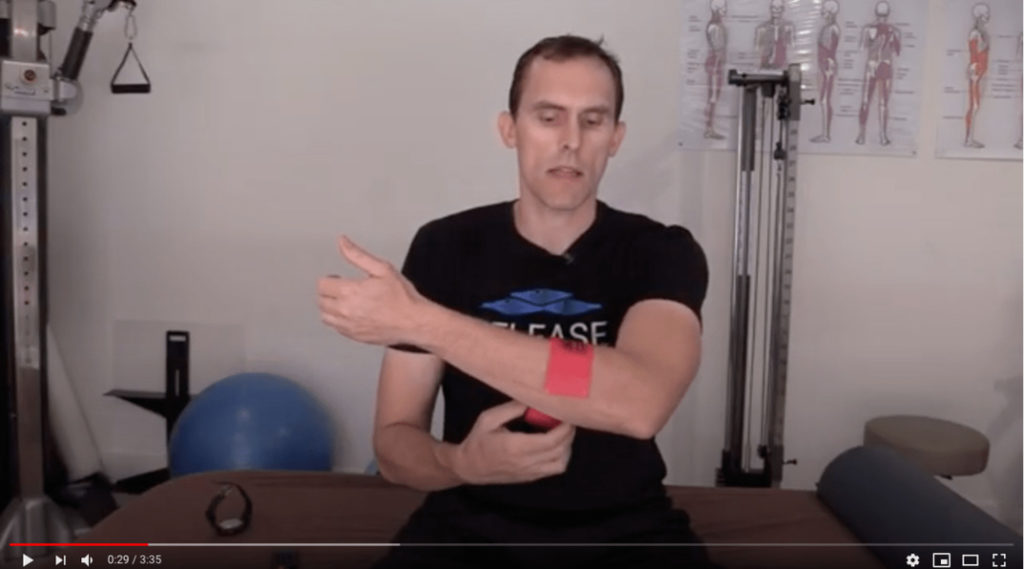
Getting the wrap started is often the toughest part. You want to make sure the first wrap around is tight so that it doesn’t unravel as you get it going.
Place the wrap around your upper forearm, then pin your arm to your stomach to hold it in place as you pull tension in the wrap to cover the loose end.
Step 2: Hold the wrap on your knee to reposition
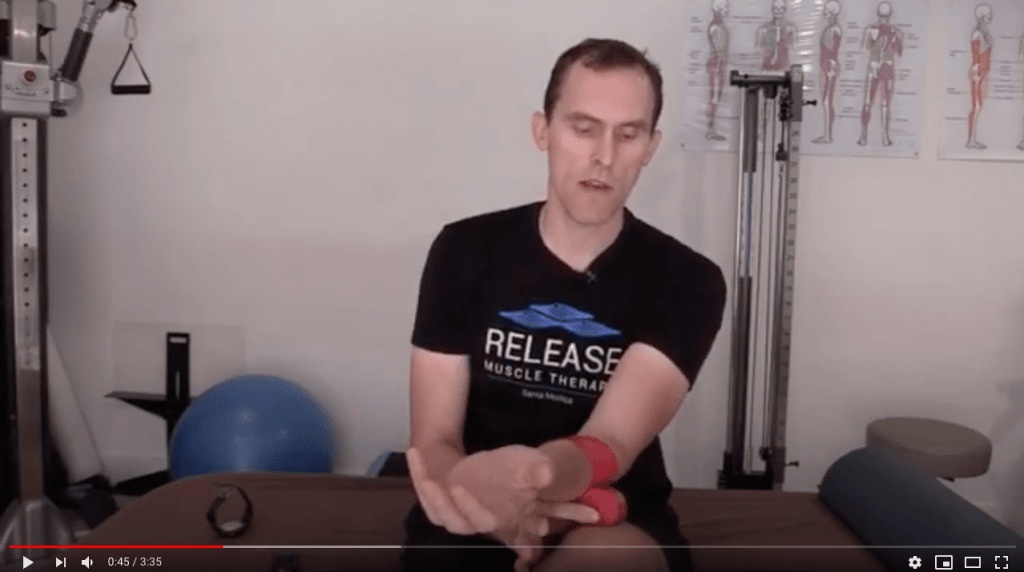
Hold the wrap down on your knee by pressing down with your elbow. Then, you can reposition your hand without the wrap unravelling. (You will do this every time you perform a wrap around in order to maintain the tension).
The goal tension of the tape should be around a 5-6 on a 10 scale in terms of max tension. You should easily be able to keep it on for 90 seconds to 2 minutes max with very little discomfort.
WARNING: Do NOT put too much tension on the band! This does not in any way make it more effective, and may cause injury!
Step 3: Continue wrapping with 50% overlap
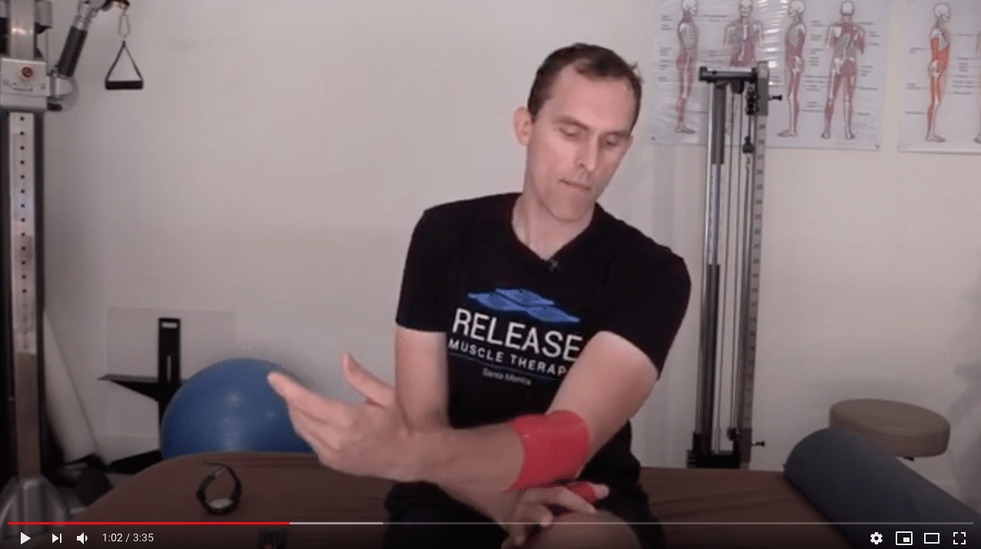
Continue wrapping the tape around the arm moving toward the elbow and over the top with approximately a 50% overlap every round.
Avoid bending the elbow too much when wrapping directly over the elbow, or you’ll lose the quality of the placement.
When you reach the end of the tape, tuck the end into the last 1-3 layers of tape so that it stays put.
Step 4: Move elbow and arm in a variety of positions for 90 seconds

Once the tape is firmly in place, begin moving the elbow and arm around in various positions (remember your biceps and triceps attach to your shoulder so move everything!).
Perform this varied movements for roughly 90 seconds to up to 2 minutes max (depending on how much tension you have on the tape) or if you feel discomfort, take it off sooner.
Step 5: After 90 seconds to 2 minutes, unravel the band and test
After 90 seconds to 2 minutes, unravel the band and move your arm around. Test any previously restricted movements and/or painful ranges of motion.
You should notice improvement ranging from minor to often dramatic!
Voodoo Floss Elbow: How To Release – Demonstration Video
Is A Short-Leg Contributing To Your Sacroiliac Joint Pain?
A very important factor to rule out in chronic SI joint pain is that of a leg length discrepancy.
When the legs are not equal length, it can make the sacral base un-level, thus contributing to stress and strain at the sacroiliac joints and lower lumbar spine.
There are 2 different types of leg length issues that you should know about:
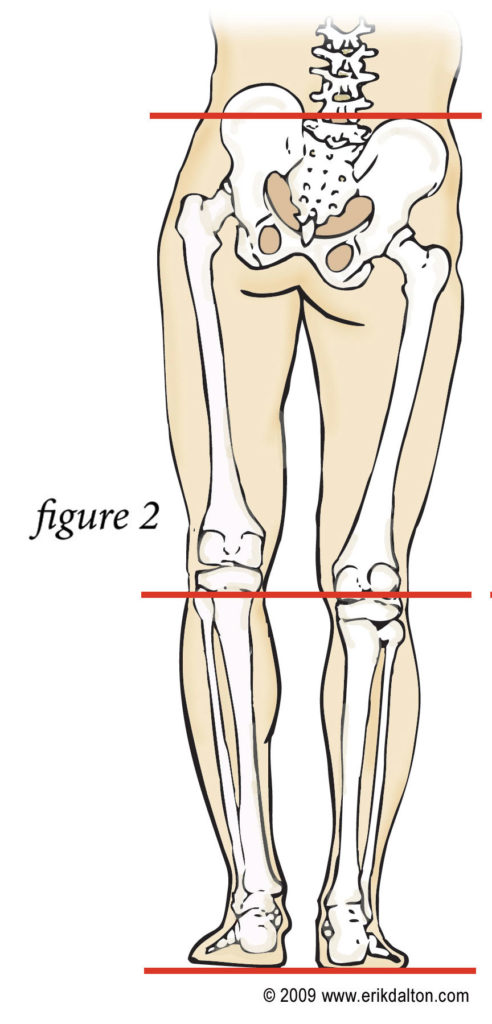
1. Anatomical Leg Length Discrepancy
This refers to when one leg is actually shorter than the other. This can be a result of injury to the joints/bones, or what you were just born with. The truth is that this type of leg length issue is very rare!
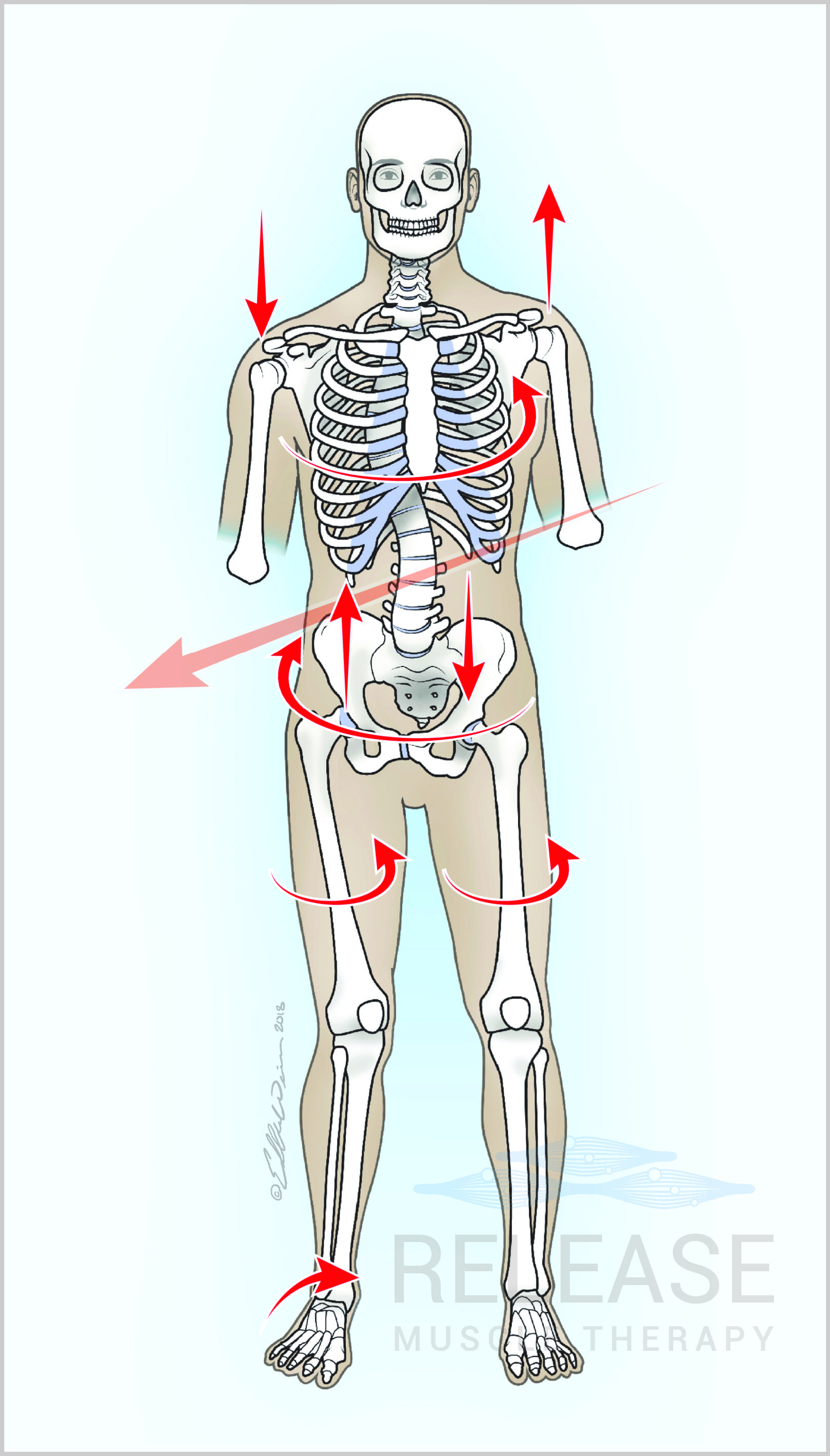
2. Functional Leg Length Discrepancy
This type is usually caused by muscle and joint imbalances, which upon correction, the leg length is restored. This is the MOST common type of leg length issue seen.
How To Test For The Two Types Of Leg Length Discrepancies
In this video, John Gibbons explains a simple test that can be used to assess leg length variation.
If a true anatomical leg length discrepancy is suspected, a full length X-ray may need to be performed to confirm.
How To Fix Functional Leg Length Discrepancy
Since functional leg length findings are associated to muscle and joint issues, they must be addressed by resolving these imbalances.
For instance, excess anterior pelvic tilt is a VERY common finding in SI joint-based imbalances and leg length discrepancy.
In the video above, I talk about the most common causes for excess anterior pelvic tilt, which include short/tight hip flexor and lower back muscles, and long/weak hip extensors and abdominals.
Related Blog Posts:
5 Special Tests To Uncover SI Joint Dysfunction
As you can imagine, much controversy surrounds manual testing for dysfunction of small joints that move as little as 2 mm. Many clinicians believe the following manual tests produce non reliable evidence of SI joint involvement in pain, but presently there are few other options.
Medically, the customary procedure for SI joint diagnosis is joint blocks via injection, but these as well have difficulty standing up to criticisms. Clearly more research needs to be devoted to the accurate diagnosis of SI joint pain.
The above, however, does not necessarily mean these tests are not clinically useful. They can provide valuable information, particularly when they are able to reproduce symptoms, and of course be used to follow up and assess changes after therapeutic interventions. Since these tests are relatively safe and easy to perform, they can be used to gather clues.
The following tests are the most customary ones, and I will not delve into more complex testing in this post, as that is better suited to a clinician’s textbook, but you should also be sure to check out my other blog post: Is A Short Leg Contributing To Your Sacroiliac Joint Pain
#1 Gaeslen’s Sign:
#2 FABER Test:
#3 ASIS Distraction:
#4 Side-Lying Sacral Compression:
#5 Femoral Shear Test:
In Summary:
It is suggested by some therapists that at least 3 out of the 5 tests above must be positive to indicate SI joint involvement, and that if all 5 tests are negative, move on to testing other areas as possible pain generators.
Physical therapist Stuart Fife, reports dismal numbers with regard to reliability and accuracy of manual testing methods, and Richard DonTigny asserts that often the correction validates the diagnosis.
Based on this information, it appears that all tests may give clues, and instead of any one given test, multiple tests should be performed to accurately test for SI joint involvement in pain, and which corrective measures should be carried out for resolution.
Need help fixing back issues? Click below and lets talk.
How To Know If Your SI Joints Are Causing Your Pain
Not too long ago, the sacroiliac joints (SIJ) were considered a primary source of lower back pain, and in particular, sciatica, however, once it was found there was no “canal that held the nerves against the joint”, the emphasis was shifted to disc herniations.
While the debate rages on, much like with spinal discs, can the sacroiliac joints be a cause of lower back pain? Well, as of recently, research is showing much more about how the SI joints can be a part of the overall pain picture.
Lets start by getting acquainted with the SI joints and how they may be cause of pain, and of course, how to address it.
What ARE The Sacroiliac Joints?
The SI joints are a part of what is referred to as the “pelvic girdle”. The main function of the pelvic girdle is to link the upper body and the lower body for movement. The pelvic girdle is made up of 3 bones and 3 joints (2 of which are the SI joints).
The bony plate at the bottom of the spine is called the sacrum, and the 2 large hip bones that are found on the left and right sides of the sacrum are called the ilia (ilium is singular). The joints at which the hip bones attach to the sacrum are the sacro-iliac joints. In the front of the pelvis, the 2 ilia are joined together by what we call the pubic joint.
The pubic joint is connected by very strong ligaments, and have opposing surfaces that keep it quite limited with regard to range of motion, but can be effected by the influence of the muscles that attach in the area, as well as hormonal changes.
The sacroiliac joints are unique in that cartilage on the sacral side is hyaline cartilage and the cartilage on the ilial side is fibrocartilage. The SI joints are L-shaped with regards to their contour, and its interesting to note that the shape of these joints vary quite dramatically from person to person, and according to Philip Greenman, DO, from side to side in the SAME person!
These joints appear to have the greatest amount of motion from age 25 to 45 (Greenman), which is very interesting, especially considering this is the age range in which back pain appears the highest, and additionally, when disc pathology is greatest.
Additionally, as both genders age, gradual changes such as fibrous adhesions and even ossification often occur, which obliterate these joints. (Grays Anatomy, Pg. 675, 1995).
2 Types of SI Joint Stability: Form and Force Closure
Generally, it is agreed there are two major stabilization systems for the SI joints, called force and form closure.
Form closure refers to the stability of the SI joints via the shape of the surfaces of the ilia on the sacrum. These surfaces are a combination of concave and convex. Force closure refers to the functioning of “slings” of muscles as well as the ligamentous support.
One such sling involves the glute maximus and opposite side latissmus dorsi as they merge into a super thick diamond-shaped area of connective tissue in the lower back called the thoraco-lumbar fascia.
How Do The SI Joints Cause Pain?
Frequently, SI joint dysfunction is overlooked and misdiagnosed, mostly due to the multiple effects that are seen as a result that make the overall situation appear to be multi-factorial and complicated. SI joint expert, physical therapist Richard DonTigny, has identified the following:
1. The glute medius is inhibited when held in anterior rotation
2. The ilial orgin of the gluteus maximus is separated from its sacral origin
3. The iliolumbar ligaments are loosened as the ilia approximate the vertebra
4. The long posterior ligaments will be stretched and may avulse from the PSIS
5. The ilial origin of the piriformis is separated from its sacral origin 6. If the sciatic nerve exits through the piriformis it may become painful
Yes, this is quite the complicated list! At first when the SI joint dysfunction appears, these may not all be present, but as the problem becomes chronic, some or all of them may appear and make it very difficult for the average doctor or therapist to see through to the root cause of the pain.
Depending on who the pain sufferer is seeing, and their specialty, normally accounts for what they will focus on correcting. This usually leads to failure, because only the symptoms are being addressed. At the root cause of course, is the mechanical dysfunction of the small SI joints!
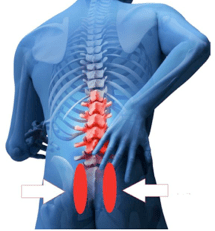


How Does Sacroiliac Joint Pain Usually Show Up?
As you can see from the image, the most obvious and common area of pain related to SI joint problems is right next to the small bones that can be felt just to the sides of the lower spinal vertebrae called the posterior superior iliac spines. (PSIS for short).
Although the picture shows a relatively small region of common pain, pain patterns associated to SI joint dysfunction are highly variable due to the complex nature of nerve innervation to the joint.
The SI joints do not commonly refer pain to the lumbar spine, but that does not mean they are not frequently involved with problems in the lumbar region. It is important to keep in mind the relationship of sacroiliac joint dysfunction to disc pathology.
Disc pathology may be exacerbated by side bending and/or rotation, therefore, when the SI joints are not balanced, they will contribute to stress on vulnerable discs. It is also possible that SI joint dysfunction may actually be a factor in causing disc bulging.
Related Blog Posts:
Need help fixing back issues? Click below and lets talk.
How To Use A Sacroiliac Joint Belt For Relief
Do These Belts REALLY Work?
In short, YES! In the video I state that the biggest issue is whether you actually HAVE pain coming from the sacroiliac joints or not. Attaining an accurate diagnosis of pain from the SI joints isn’t that easy, simply because there isn’t an established “gold-standard” test.
Is there a simple test to find out if the belt COULD work for YOU?
Yep! In the video above, I show a test that can be performed while lying on your back. Since the belt’s job is to compress the pelvis, we can mimic this action with a set of hands. Definitely ask someone to do this for you, which will be a much better test than attempting it on yourself.
Does it matter if you put the belt on standing vs. sitting vs. lying down?
Yes. I recommend only putting on sacroiliac joint belts while lying on your back, AFTER doing your corrective mobilizations.
SI Belt – How To Wear
There are a few things to know when wearing an SI belt. The video I created for Youtube has received tens of thousands of views and the comments clearly show that most people were not applying the belt correctly.
If you follow the steps I outline, you’ll get the most out of the belt and get results if indeed the belt is what you really need.
How tight does the belt need to be?
Its important to understand that the emphasis should be placed on the position of the belt, NOT how tight it is. One study in particular showed that a belt with a tension of 100 N did not significantly differ from one at 50 N in terms of reducing sacroiliac motion.
Which belt is the best?
Sacroiliac joint belts all do the same thing so its really a matter of comfort, since most people who benefit from it will wear it often. Nothing is worse than having to deal with a poorly designed belt that is constantly riding upward when you sit or move.
Does relying on an SI belt make your own muscles weak?
No. Using a sacroiliac joint belt is not the same type of thing as a lumbar spine brace. SI joint instability is a ligamentous/joint problem. Since there are no muscles that directly move those joints, wearing the belt will not weaken anything. You can wear it 24/7 if you want.
Related Blog Posts:
Need help fixing back issues? Click below and lets talk.
[video_player id=”3ff43f6b5782fc5a580e9221949a18af” url=”https://vimeo.com/250834727″ width=”80%” video_ratio=”16_9″ placement=”left” image=”” image_size=”large” placeholder_icon=”on” placeholder_icon_style=”style1″ custom_class=”” _fw_coder=”aggressive” __fw_editor_shortcodes_id=”039ed59472ca1efb6aa27ac7b67d8b47″][/video_player]
]]>